Understanding Service Dog Harnesses
Purpose | Function | Responsibility

Service dog harnesses are not simply identification gear, they are specialized tools designed to support highly specific mobility and balance tasks. Understanding Service Dog Harnesses is critical when working with your service dog. When fitted and used correctly, a harness allows a service dog to communicate clearly with their handler and safely assist with movement, balance and navigation. When used incorrectly, however, the same equipment can place unnecessary strain on the dog and increase the risk of injury to the dog and/or handler.
This newsletter is intended to help handlers, especially those new to mobility work to understand what harnesses are designed to do, how they should be used and why proper training and restraint are critical.
Why Mobility Service Dogs Work in Harnesses
Mobility harnesses allow service dogs to assist their handlers through tactile feedback, positioning, balance and controlled resistance rather than force or control. Most mobility tasks rely on subtle changes in pressure that both the handler and dog are trained to recognize and respond to.
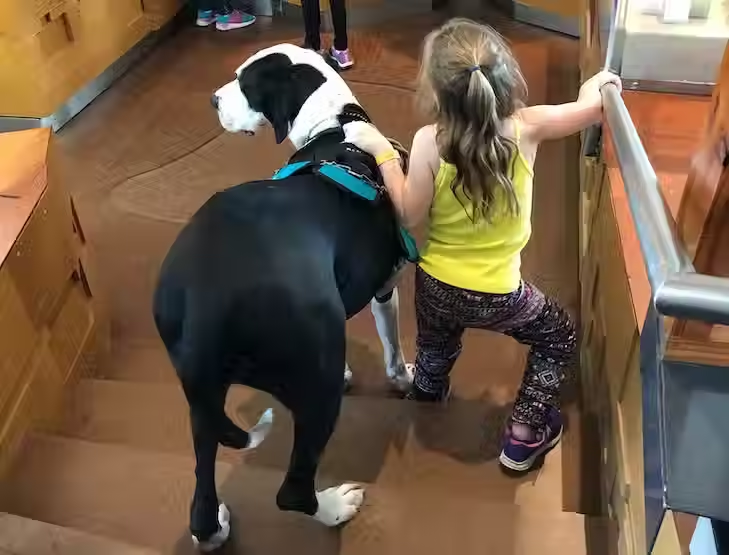
Think of the harness as a communication bridge, not a steering wheel.
Common Mobility and Balance Tasks Performed in Harnesses
Spatial Orientation Assistance
This is one of the most foundational mobility tasks. The handler maintains light contact with the harness handle, similar to touching a wall or countertop for stability. This contact helps the person orient themselves in space and maintain balance while standing or walking. Many handlers describe this as being able to “feel the ground through the dog.”
Handles used for this task are typically soft or flexible, though some may be semi rigid to remain upright for easy access. Our shop prefers semi rigid handles always for counter balance.
Guiding / Leading
In guide work, the dog moves slightly ahead of the handler and applies light to moderate forward pressure.
This allows the dog to:
Communicate direction changes
Indicate elevation changes (curbs, steps, ramps)
Lead the handler to specific locations such as doors, exits, chairs, or vehicles
Avoid obstacles and hazards
Refuse to continue if a path is unsafe.
Guide handles are usually longer and rigid, often with a pivoting or flexible connection to allow natural movement while maintaining clear tactile feedback, especially for Blind or Visual Impaired individuals Guide handles for forward momentum pull have more flexibility when it comes to needs and expectations.
Counterbalance
Counterbalance tasks help stabilize the handler while standing or moving.
The dog acts as a counterweight, responding to changes in pressure through the handle:
Light upward or backward pressure (NOT DOWNWARD) signals the dog to lean appropriately
The dog’s body mass provides stability not strength or lifting.
This task can be used while standing still (anchor bracing and can be taught at younger ages) or in motion (true counter balance and must be 2 and cleared) and is often safer and more appropriate than bracing for many handlers.
Momentum Pull
Momentum pull is a gentle, continuous assist that helps keep the handler moving forward.
This task:
Supports gait rhythm and cadence
Helps conserve energy
Combines elements of guiding and counterbalance
There should be light but constant tension on the handle, allowing both the dog and handler to feel and respond to each other’s movement. However, the dog should not be pulling handler from a static position this is for an individual already in motion.
Pull Up Assistance
In this task, the dog provides momentum to help the handler rise from a seated or static position.
The dog leans into the harness while the handler performs most of the work of standing. The dog assists with balance and timing but not lifting.
Body Blocking
Body blocking is a safety task where the dog physically prevents forward movement.
The dog steps across the handler’s path and holds position. In some cases, the dog may lean slightly into the handler, and the handler may rest their hands on the dog’s back for orientation but not pressure.
A Critical Note on Bracing
Bracing involves downward pressure on a rigid, vertical handle and is one of the most misunderstood and misused mobility tasks. With more recent teachings within programs, this task is slowly being phased out and no longer being used. We have letters from Veterinarians that state that no dog should be having any form of downward bracing as their backs and bodies were not built or meant for that.
While it can assist briefly with balance during transfers or when navigating steps without railings, bracing:
Must involve no more than a few pounds of pressure (1–1.5 kg)
Must be infrequent, brief, and minimal
Must never be used continuously while walking
Many people who believe they need bracing are often better served by counterbalance and momentum based tasks, which place far less strain on the dog.
Bracing guidelines referenced here are based on standards from the International Association of Assistance Dog Partners. Our own training program does not allow bracing accept in absolute emergency situations. This is why our shop takes precautions to prevent our gear from being used to brace.
Why Bracing Requires Extreme Caution
The handler is responsible for most of the movement and alignment
The dog assists with balance only
Rigid handles apply torque directly to the dog’s spine, which can amplify force
Dogs are not mobility devices (canes, crutches, or walkers)
Rigid metal handles are not recommended for individuals who:
Have tremors or uncontrolled movement
Are prone to misusing equipment (not even realizing they’re leaning onto the handle while standing for balance)
Under no circumstances should a handler:
Lean on the dog
Twist, pull sideways, or rotate the handle
Steer, correct, or restrain the dog using the harness
Wheelchair Pulling: Limited and Situational
Wheelchair pulling may be appropriate occasionally and for short durations. This is yet another task that is controversial but should be discussed.
The handler must always control the chair’s speed and direction.
The dog may assist with:
Maintaining momentum on flat, hard surfaces
Providing a brief boost over small obstacles or bumps
Helping on ramps or inclines momentarily
The dog should move alongside the wheelchair and not out in front while remaining in a straight line. Leaning or crab walking indicates excessive or uneven force and should be addressed immediately.
Wheelchair pulling is not a replacement for power chairs, SmartDrive systems, or other mobility aids.
Proper Use of a Mobility Harness
Handles Are for Humans! Did we say this already? Good, let’s repeat ourselves.
Harness handles are designed for:
Communication
Tactile feedback
Limited physical support
They are not for controlling the dog!
Always:
Use equipment exactly as designed
Select a harness appropriate for the specific task (not sure ask your gear maker that is back by an orthopedic veterinarian)
Learn correct positioning and body mechanics
A Harness Does Not Replace a Leash
A leash is still required for control and management. If guidance or correction is needed, it should be done through the leash and not the harness.
Training collars or head halters may be used appropriately but are never substitutes for proper training.
Train the Dog for Harness Work
Dogs must be trained to understand:
Changes in pressure
Handler movement and positioning
Verbal cues such as forward, left, right, halt, back
A dog should never be corrected or steered using the harness.
If the dog is out of position:
Let go of the handle
Reset
Cue the correct behavior
Allowing improper pulling reinforces unsafe habits.
What Research Tells Us About Harnesses
Harness research is ongoing, and the science is far more nuanced than social media discussions often suggest.
A limited 2013 study by Chris Zink found that all harnesses altered gait to some degree, even without a leash attached. Chest strap design influenced movement, but conclusions were often oversimplified into “restrictive vs non restrictive = good vs bad.”
Follow up research, including a 2018 study on weighted pulling (NOT service work), showed:
Both Y shaped and straight chest straps affected shoulder extension
With weight added behind the dog, Y shaped harnesses sometimes restricted movement more than expected
Proper fit, dog conformation and real world use matter as much if not more than strap shape alone
What We Still Don’t Know when it Comes to Service Dog Harnesses
Long term effects of any harness style
How handler movement influences the dog
How design affects different breeds and body types
Whether materials, strap width or coat length play a role
Direct links between harness use and injury
The Takeaway:
There is no universally “safe” or “dangerous” harness—only appropriate or inappropriate use of one and that the heavier or stiffer the harness, the more taxing it could be on the dogs body thus possibly shortening its working life.
Final Thoughts
Mobility harnesses are powerful tools that can dramatically improve independence and quality of life when used thoughtfully and conservatively. They require education, training, restraint and respect for the dog’s physical limits.
When in doubt, less force, better training, and safer alternatives should always come first.
Questions?
Would you like us to elaborate on any of the different areas we touched on?
Our shop follows the IAADP’s standards for mobility when it comes to gear recommendations as well as personal preferences based off of experience, research and education.
Comments